

Haas School of Business at UC Berkeley
responsiblebusiness.haas.berkeley.edu
 

Volume 3
Winter 2011

Sustainable Consumption: The Challenge and Opportunity


In just twenty years, by the time today's toddlers reach college, global consumption will have fundamentally changed: 2.6 billion new consumers will have joined the middle class, expecting and demanding the same quality of life that Americans enjoy today. Low-income consumers will represent a market of another $5 trillion.

According to the Global Footprint Network we would need five planets to sustain consumption if everyone lived like the average American and those numbers are based on resources available now. Availability of resources, from freshwater to indium, continues to decline. China's announcement last month of further reductions in its exports of rare earth metals, critical for manufacturing everything from cell phones to electric cars, shows that companies are already facing serious limitations on resources. Clearly, something needs to change.

What would sustainable consumption look like? (For our commentary on whether 'sustainable consumption' is the right phrase, see our post on GreenBiz.com). Businesses who are thought leaders in this area share a vision of an economy based on selling value, rather than quantity. Ford and BMW speak of becoming "mobility" companies rather than companies that sell cars. In a world where consumption is sustainable, business would provide products and services that meet needs within environmental, economic, and social constraints.

The proliferation of new product-sharing websites like Neighborgoods or Frenting, which allow consumers to easily borrow rarely-used items like tents or tools from neighbors or friends, demonstrates new consumer appetites for different modes of consumption. At the same time, though it's clear that there's growing concern about sustainability issues among consumers, there remains a gap between the desire of consumers to support responsible business and their actual behavior. If a more sustainable option happens to cost more, or doesn't match performance, or isn't as convenient, it's likely to stay on the shelf.

The first role of business, then, is to innovate so that the products and services they provide have maximum value and desirability, and cause minimum social and environmental harm. Ultimately, every option in a store should be a good option-- Walmart, for example, has a straightforward goal of selling "products that sustain people and the environment," period.

Until we reach that point, business has another important role to play in influencing consumers to make the right choices along the lifecycle. For some companies, that may mean better education and marketing to influence purchasing decisions. For others, like Levi's (which discovered that one of the largest environmental impacts of a pair of jeans was washing and drying), it may mean helping consumers use a product or service differently. Others may focus on consumer behavior at the end of a product's life.

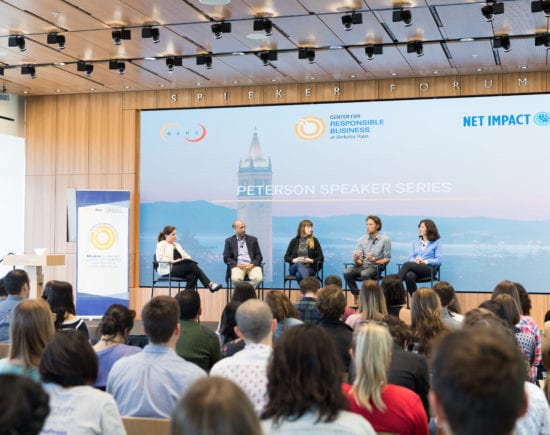
The challenges of transitioning to sustainable consumption also present opportunities for innovation in business models, whether that's moving from selling products to services (like IBM, which now focuses on customized IT solutions rather than computer equipment), or creating an entirely new type of business (like Better Place, which is building the infrastructure and systems to enable adoption and use of electric vehicles). Over this semester at the CRB, we'll be addressing new business models for sustainable consumption in a panel discussion as part of the Peterson Lecture Series we host. We'll also have events focused on sustainable product design, changing consumer behavior, life-cycle analysis, and hold a workshop exploring how design thinking can be used to address a challenge in sustainable consumption. Best Buy's Kai Patel, featured in the next article, will be joined in conversation by Aron Cramer, CEO of Business for Social Responsibility on February 2.

Closing the Loop on Sustainability:
Levi's Undergraduate Case Competition


What happens when you bring left-brainers together with right-brainers? This semester, the Center for Responsible Business (CRB) partnered with California College of the Arts (CCA) to find out. Sustainable fashion design students from CCA were paired with students from UC Berkeley to work on the Levi's Sustainability Undergraduate Case Competition. Participants were asked to create innovative solutions on how Levi Strauss can "close the loop profitably" with denim recycling, reuse, and resale.

Last Spring, the Center for Responsible Business worked with Target to put on an undergraduate case competition that utilized social media to engage students. This semester, we continued to challenge students to communicate their ideas through a 2-minute YouTube video and blasted helpful hints and tips on Facebook and Twitter during the two-week case competition.

Perhaps the most unique aspect of the case competition was the CRB's partnership with CCA. Three students from UC Berkeley were matched with two fashion design students, and the cross-functional, multi-disciplinary teams were asked to collaborate on a solution, integrating design thinking with business knowledge. Each team's final deliverables included not only a YouTube video and oral presentation, but also a physical prototype of the proposed solution or product.

Asking the teams to provide a physical prototype of their idea allowed students to commit and engage fully in developing their solutions. The prototypes included jean jackets, raw materials for textile production, a new type of stitching, a jacket made from recycled denim yarn, replacement pant pieces, and even handkerchiefs. The winning team – with members Zahin Ali, Leslie Chen, Cecilia Xia from UC Berkeley, and CCA students Jean Saung and James Zormeir – proposed that Levi's create a one-of-a-kind "Levi's Strauss" handkerchief. These handkerchiefs,made from recycled denim and cotton, have various uses, from napkins to a bracelet accessory. Check out the team's video.

Jo Mackness, Executive Director at the CRB, was equally pleased with the outcomes of the competition. "The teams from the different schools were challenged to come together and develop a solution that was not only creative, but business viable, and of course environmentally sustainable," she said. "We were trying to create an experiential learning opportunity that mimics the cross functional context within which students will eventually operate in the 'real world' —interestingly, it was the students who collaborated the best—really embraced their team mates' ideas, who came out with the best all around solutions."

The goal of the competition was to further Levi Strauss' commitment to sustainability by developing innovative ways to "close the loop profitably". UC Berkeley and CCA students came together successfully to not only tackle the case from both a design and business perspective, but more importantly, apply the skills and knowledge they learned in the classroom (and studio, for CCA students) to a real-world business challenge. We were blown away by each team's creative and rigorous solutions to this case and look forward to what students have to offer in next year's case competition!

Exploring the Future of Extended Producer Responsibility


Around the world—and at the state level in the U.S.—policy on extended producer responsibility is quickly growing. Extended producer responsibility (EPR) is a strategy that places shared responsibility on manufacturers for what happens to products when consumers no longer want them.

In November, the Sustainable Products and Solutions Program at CRB hosted a roundtable on EPR that brought together manufacturers, retailers, NGOs, academics, and waste management companies together to explore solutions and opportunities in EPR. The event was co-hosted by the California Product Stewardship Council.

One focus was electronics. As continuous, short-term sales cycles push out more and more electronics- with components that are both valuable and sometimes hazardous-- manufacturers are now dealing with the issue of e-waste. 24 states have passed laws mandating e-waste recycling, and more laws are on the way. At the roundtable, one focus of discussion was the challenge of passing a uniform national e-waste law.

As the day progressed, and experts shared stories of everything from Best Buy's comprehensive consumer electronics recycling program (see PDF) to the huge opportunities for recyclers to recover valuable materials (see PDF), the topic of how to move forward on policy returned again and again.

The next day, as the roundtable focused on the challenges of EPR for packaging, the same theme emerged. How can the U.S. create harmonized law(s) on EPR, rather than myriad different state programs? How can we best work with states, since that's where the action is? How can we prevent exportation of toxic waste to other countries?

The answers are far from simple, but one interesting model was suggested by Bill Shireman, President and CEO of Future 500. Shireman was a leader in enacting California's Bottle Bill, and explained how he worked with allies to make that legislation successful. His recipe? Bring together a critical mass of key stakeholders-- NGOs, funder alliances, advocates, a few key brand owners and retailers, and reach agreement among them, then use that coalition to push for policy change. In the end, Shireman believes there's no question that EPR is coming to the U.S., and business will play a critical role in making that happen successfully.

PERSPECTIVE
The Future of Finance: New CRB Initiative

Will Morrison, CRB Program Manager

It seems as though the dust from the financial crisis has settled. The Dodd-Frank Wall Street Reform Act has been passed, banks' profits are back up, and aggregate levels of compensation are being announced with little fanfare. But look a little deeper and it's apparent that the financial industry has not yet regained its footing. Earlier this month Barclay's CEO Robert Diamond said the time had come to stop criticizing banks so they could get on with their work; at the same time, Barclay's ran a commercial gently mocking bankers' famous self-confidence. Morgan Stanley's Chief Executive James Gorman railed against Wall Street's glorification of individual performance while industry-wide compensation is expected to inch up 5% for the year.

Financial industry leaders may not be speaking with a unified voice, but they may need to make a concerted effort to do so in light of anger and a mixed public opinion of the financial industry. Recent research by global public opinion research firm GlobeScan shows that levels of global public respect for the banking industry have fallen since the 2008 financial crisis, especially in the US and Europe. Banking is now classified as a "lagging" industry in terms of reputation, alongside the petroleum and chemical industries. In the same period that respect for the banking industry declined, traditionally slow-moving industries like mining and automotive made progress in engaging the public.

With leaders divided on their plan for moving forward and a hardening of public opinion against the industry, banking – and the finance industry as a whole – is at a critical point. Leaders face a choice: go back to business as usual in hopes of maintaining a low profile or start making changes to the way they do business and potentially redefine the financial industry's relationship to society.

So what should leaders do? At this critical point, gaining direction has as much to do with leadership and communication as it will have to do with practicing "responsible finance." Banks like Goldman Sachs have taken important first steps to addressing problems by examining internal issues like reporting, conflict of interest and risk disclosure, and have recently shared the results with the public. Whether the 39 recommendations in Goldman's report will be more than window dressing remains to be seen. Mixed reactions to news of the report indicate that the public remains skeptical of Goldman's intentions.

Ultimately, banks will need to take this opportunity to engage with stakeholders – including the public, regulators, employees, and others – to understand how they can take a proactive role in ensuring shared responsibility for lessening the blow of another financial crisis and demonstrate a commitment to making change.

The Center for Responsible Business understands the important decisions financial industry leaders will have to make and will play an active role in fostering discussion and identifying solutions. With support from financial institutions around the globe, the Center has engaged leaders in industry, academia, government, and media to gather opinions and produce a vision for the future of the financial sector, which will be detailed in a report this spring. Recognizing the complexity of the financial industry and the challenges it faces, this Future of Finance initiative will gather stakeholder perspectives on the role the financial industry plays in society and, with the participation of partner banks Goldman Sachs, Citi, Barclay's, BBVA, and ANZ Bank, it will help frame the discussion to channel feedback into constructive proposals to the industry and society at large. This is a joint program between the Center for Responsible Business and GlobeScan.


NEWSWORTHY

Sustainable Products and Solutions Program grantee Ashok Gadgil was featured on ABC News. Learn more about Gadgil's work in this clip from ABC. SPS supports the Darfur Stoves and arsenic remediation projects featured in the story.

Professor Omar Romero-Hernandez, member of the Haas Operations and Information Technology Management group, and a current SPS program grantee for his work in green supply chain research, has recently been presented with the World's Distinguishing 2010 Franz Edelman Award for Achievement in Operations Research and the Management Sciences. Every year, the Franz Edelman competition recognizes outstanding examples of operations research (O.R.)-based projects that have transformed companies, entire industries, and people's lives. Past Franz Edelman winners include HP, Memorial Sloan Kettering Cancer Center, Merrill Lynch, Motorola, and IBM. Additional information about the Edelman Competition is online here.


FOCUS
Kevin Casey, Founder and CEO, New Avenue

Since the financial crisis of 2008, incomes have stagnated, housing values have fallen, and mortgages have become less accessible than ever. In the economic downturn some 85% of Bay Area residents can't afford a median-priced home.

Kevin Casey, Founder and CEO of New Avenue Homes, sees this crisis as an opportunity. Casey founded New Avenue on the belief that homes should be affordable to the average family, sustainably constructed, and adapted to fit a dense urban landscape. The startup offers an innovative design, financing and building program to manage the entire process of creating in-law cottages and small, efficient homes.

"Many of our clients are older and want to age in place or downsize. Others just want to share their home. Ultimately, the appeal is the cash flow and freedom that come with cottage living."

He hopes the New Avenue model will help address affordable housing issues in places like Berkeley, Seattle, and Asheville, NC, which already have laws that encourage urban infill and permitting for cottages like New Avenue's.

Casey started toying with the idea for New Avenue the summer between the first and second year of his MBA at Haas. While taking Design for Sustainable Communities, taught by Ashok Gadgil, of Lawrence Berkeley National Lab, he recruited a team that included members with backgrounds in engineering, environmental design, and urban planning to develop an initial business model for New Avenue. Seed funding from the Center for Responsible Business' Sustainable Products and Solutions program got New Avenue off the ground, and followup funding from the Clinton Global Initiative, among others, helped the idea become a reality.

If an open house at a recently-completed project is any indication, New Avenue's model is gaining traction. Over 500 people including leaders in state and local government, the environment, and academia, as well as the general public visited a cottage built in the back yard of Karen Chapple, an associate professor of city and regional planning and faculty director of the Center for Community Innovation at UC Berkeley. Made of sustainable and recycled materials and built to be energy neutral, the cottage will be rented to two firefighters and their son who split time between Berkeley and Oregon.

Eventually, Casey says he hopes New Avenue will fund $1billion in urban infill development. If the magnitude of the problem is any indication, the opportunity huge. As Casey like to put: "We have250 leads and 25 million in the pipeline."


Center for Responsible Business Facebook page Center for Responsible Business: Twitter Center for Responsible Business: JustMeans Center for Responsible Business: LinkedIn Center for Responsible Business Home Page